
Most websites take 4 to 12 weeks to build. A simple five-page business site typically takes 3–6 weeks, a custom design with a CMS takes 6–12 weeks, an e-commerce store takes 8–16 weeks, and a custom web application takes 3–12 months. Template-based sites can launch in under a week.
The bigger truth: the developer’s speed is rarely what determines your launch date. In most delayed projects, the bottleneck is content, feedback and decision-making on the client side. This guide gives you a realistic timeline and shows you exactly where projects lose weeks.
Timeline by project type
| Project type | Realistic timeline | Rushed minimum | Common overrun |
|---|---|---|---|
| Single landing page | 3–7 days | 1 day | +3 days |
| Template site (5 pages) | 1–3 weeks | 4 days | +1 week |
| Custom small business site | 4–8 weeks | 2 weeks | +2–3 weeks |
| Custom site with CMS + blog | 6–12 weeks | 4 weeks | +3 weeks |
| E-commerce store (under 100 SKUs) | 8–16 weeks | 5 weeks | +4 weeks |
| Large e-commerce (1,000+ SKUs) | 4–8 months | 3 months | +6 weeks |
| Website redesign + migration | 6–14 weeks | 3 weeks | +4 weeks |
| Custom web application | 3–12 months | 8 weeks | +8 weeks |

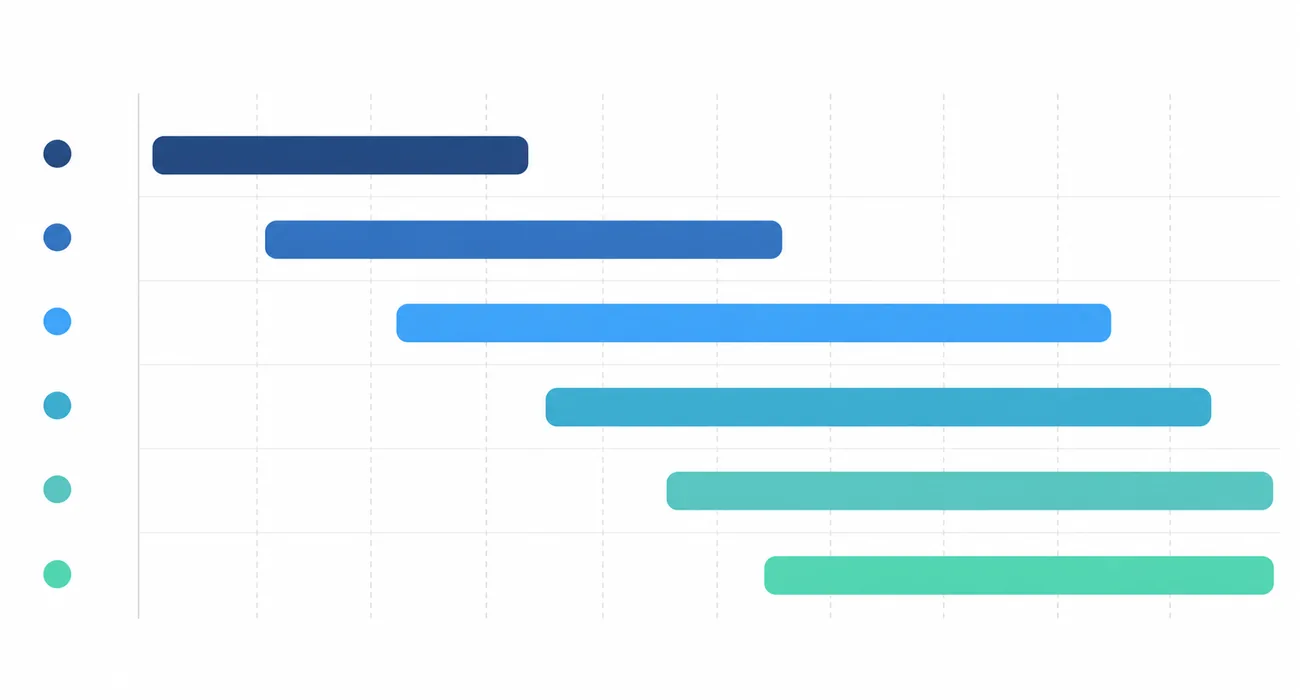
The week-by-week process (typical 8-week build)
Week 1 — Discovery and strategy
Kickoff meeting, business goals, target audience, competitor review, technical requirements, and success metrics. A sitemap is agreed and signed off. Skipping or rushing this phase is the leading cause of expensive rework in week six.
Client responsibility: attend the kickoff, provide brand assets, answer the strategy questionnaire.
Week 2 — Information architecture and wireframes
Low-fidelity layouts for each unique page template — no colours, no images, just structure and hierarchy. Changes made here cost minutes; the same changes in week seven cost days.
Client responsibility: review wireframes and approve within 3 business days.
Weeks 3–4 — Visual design
Homepage design first, then interior templates. Typically two revision rounds are included. Design sign-off is a hard gate: development shouldn’t start on unapproved designs.
Client responsibility: consolidate all stakeholder feedback into one document per round.
Weeks 5–6 — Development
Front-end build, responsive implementation across breakpoints, CMS setup, forms, integrations, and back-end functionality. This runs fastest when content is already supplied — building with real text is significantly quicker than building with placeholder text and retrofitting later.
Client responsibility: deliver final copy and images. This is where projects most often stall.
Week 7 — Content population, testing and QA
All content loaded, then cross-browser testing, mobile testing across real devices, form and payment testing, accessibility checks, speed optimisation, and SEO configuration (meta tags, schema, sitemap, redirects).
Client responsibility: review the staging site thoroughly and submit one consolidated list of issues.
Week 8 — Launch and handover
DNS changes, SSL verification, analytics and Search Console setup, 301 redirects for redesigns, final performance pass, CMS training, and documentation handover. Then a 24–48 hour monitoring window for issues that only appear in production.
What actually causes delays
Industry-wide, most website projects overrun. The causes are predictable:
1. Content isn’t ready (the #1 cause)
Clients consistently underestimate copywriting. Writing 8 pages of good website copy takes 15–30 hours. If the developer is waiting on content in week five, the project is already late. Fix: write copy during weeks 1–3, in parallel with design, or budget for a professional copywriter from the start.
2. Slow or fragmented feedback
A three-day review turning into two weeks, repeated across four approval gates, adds a month. Feedback arriving piecemeal from five stakeholders across separate emails is worse than slow feedback. Fix: name a single decision-maker and agree a 48–72 hour review SLA in the contract.
3. Scope creep
“Can we also add a booking system?” in week six is a new project, not a tweak. Every mid-build addition costs its own build time plus re-testing of everything around it. Fix: maintain a phase-two list and add every new idea to it rather than the current build.
4. Excessive revision rounds
Two rounds per stage is standard. Endless revision usually signals that strategy was skipped — the team is redesigning because nobody defined what success looks like. Fix: cap rounds contractually and resolve direction at the wireframe stage.
5. Third-party dependencies
Waiting on API access, payment gateway approval, hosting credentials, brand assets from another agency, or legal review of terms. Fix: list every external dependency in week one and start the slowest approvals immediately.
6. Late-arriving stakeholders
An executive who first sees the site in week seven and dislikes the direction can reset the project by a month. Fix: get every approver into the wireframe and design sign-offs.
How many revisions are normal?
| Stage | Standard included rounds |
|---|---|
| Wireframes | 1–2 |
| Homepage design | 2 |
| Interior page designs | 1–2 |
| Development QA | 1 consolidated issue list |
| Post-launch bug fixes | 30–90 day window |
Anything beyond this is normally billed at an hourly rate. Rates vary widely by market and seniority, so the figure that matters is the one written into your contract — agree it before you sign rather than discovering it at revision three, and check it against the overall budget you’ve set. Contracts that promise “unlimited revisions” are either priced defensively high or heading for a dispute.
Can you build a website faster?
Yes — legitimately, and without cutting quality:
- Write all content before design begins. This single change removes the most common delay entirely.
- Use a premium theme or template instead of full custom design. Saves 2–4 weeks.
- Reduce the launch scope. Ship 6 strong pages now, add 10 more in phase two.
- Assign one decision-maker with authority to approve without committee review.
- Book review sessions in advance so calendars don’t cause the delay.
- Supply all assets on day one: logo files, brand guidelines, photography, existing analytics access, hosting credentials.
- Use an established platform rather than custom architecture for standard requirements.
What not to compress: testing, mobile QA, accessibility, and SEO setup. These are where rushed projects quietly fail, and the cost surfaces three months later as lost traffic and broken forms.
Redesign vs new build: which takes longer?
Redesigns are often assumed to be faster because content exists. In practice they take similar or longer time because they add:
- Content audit and inventory of existing pages
- URL mapping and 301 redirect planning
- Preserving rankings for pages that already perform
- Migrating existing content, media and integrations
- Coordinating a cutover with minimal downtime
Budget an extra 1–3 weeks over an equivalent new build, especially if the URL structure is changing. Rushing the redirect map is how businesses lose the majority of their organic traffic on launch day — it’s one of the first things we check in a website audit.
Frequently asked questions
How long does it take to build a simple website?
A simple five-page template-based website takes one to three weeks including content and revisions. With all content prepared in advance and no custom design required, an experienced developer can complete it in four to seven days.
Why do website projects take so long?
The largest delays come from client-side factors: content not being ready, slow or fragmented feedback, and mid-project scope changes. Actual design and development on a standard small business site takes roughly three to five weeks; the rest is waiting and revision cycles.
How long does an e-commerce website take to build?
A store with fewer than 100 products typically takes 8 to 16 weeks, covering platform setup, design, product data entry, payment and shipping configuration, and testing. Catalogues over 1,000 SKUs commonly take four to eight months.
How many revisions are included in a website project?
Two revision rounds per design stage is standard, plus one consolidated issue list during QA and a 30 to 90 day post-launch bug-fix window. Additional revisions are normally billed at an hourly rate, which varies by market and seniority — agree the figure in the contract before work starts.
Can a website be built in one week?
Yes, for a landing page or template-based site where all content is ready and no custom design is required. Custom design, CMS setup, e-commerce functionality and integrations cannot be completed properly in a single week.
How long does a website redesign take?
Typically 6 to 14 weeks, often longer than an equivalent new build, because redesigns add content auditing, URL mapping, 301 redirect planning and SEO preservation work on top of design and development.
What should I prepare before a website project starts?
Logo and brand files, photography, written copy for every page, a list of required functionality, competitor examples, hosting and domain credentials, analytics access, and one named decision-maker. Preparing these in advance is the most effective way to shorten the timeline.
Conclusion
Four to twelve weeks is the honest range for most business websites, and how close you land to the lower end depends more on your preparation than your developer’s speed.
Have your content written, name one decision-maker, agree review deadlines in the contract, and keep new ideas on a phase-two list. Projects that do these four things routinely finish on schedule. Projects that don’t are the reason the average overrun exists.
If you want a realistic timeline and a fixed price for your own project, start with a free audit — you’ll get a written scope and a date before committing to anything.